



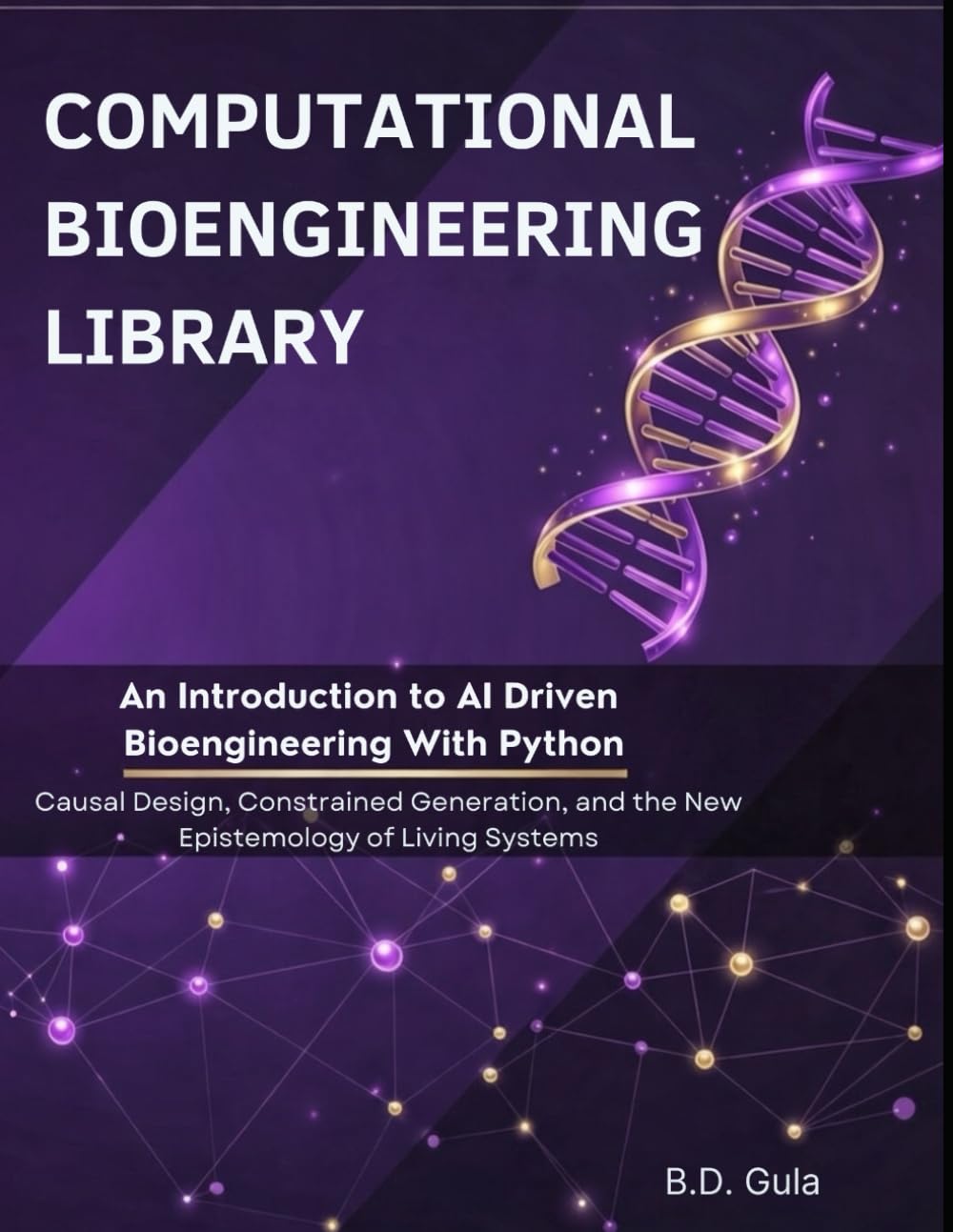
An Introduction to AI Driven Bioengineering With Python: Causal Design, Constrained Generation, and the New Epistemology of Living Systems (Computational Bioengineering Library) Paperback – February 19, 2026

 4.8 (84 items)
 Limited Time Sale
US$27.54 cheaper than the new price!!
Free cash-on-delivery fees for purchases over $99
Product details
| Management number | 219240646 | Release Date | 2026/05/03 | List Price | US$18.36 | Model Number | 219240646 | ||
|---|---|---|---|---|---|---|---|---|---|
| Category | |||||||||
Biological engineering has quietly crossed a threshold: the decisive challenge is no longer whether we can edit, synthesize, or measure life, but whether we can think about biological possibility in a way that is computationally legible without flattening what makes biology irreducible.This book approaches AI driven bioengineering as a discipline of design under epistemic constraint, where sequences are not merely strings, phenotypes are not merely labels, and experiments are not merely validation. You will learn to treat biological reality as a set of interacting spaces: design spaces, causal spaces, uncertainty spaces, multi-objective tradeoff surfaces, and the shifting “ritual” boundary between what your lab can observe and what your model can responsibly infer. The result is a framework that feels less like a catalog of techniques and more like a set of precise mental instruments for navigating the hidden structure of living systems.Rather than repeating familiar narratives about models getting “more accurate,” it focuses on the deeper tensions that decide whether AI accelerates discovery or industrializes self-deception: when embeddings become predictive but non-editable, when novelty floods your pipeline but function refuses to appear, when closed loop optimization learns your protocol signatures instead of biology, when safety constraints mutate into loopholes, and when domain shift is not a bug but a biological fact produced by the measurement context itself.A distinctive emphasis is placed on customization across teams, organisms, tissues, assay definitions, and deployment contexts. The same algorithm that wins in an enzyme program can fail catastrophically in a patient-specific setting, not because the code is wrong, but because the semantics of “fitness,” “uncertainty,” “off-target,” “identity,” and “success” are tenant-dependent. You will learn how to reframe models as configurable instruments, calibrated to the epistemology of each lab and the operational reality of each domain.Each chapter includes full Python code demos, not as ornamental notebooks, but as executable arguments: uncertainty priced as experimental currency, causal models that respect intervention semantics, constrained generation that internalizes manufacturability, ecological design for microbiomes, control-theoretic gene circuits, digital twins as living hypotheses, and federated biolearning that preserves signal without collapsing minority domains.This is written for readers who want more than capability. It is for those who want intellectual traction on the deep structure of engineered life, and who suspect that the most important advances will come from asking better questions than “does it work?” Read more
| ISBN13 | 979-8248977932 |
|---|---|
| Language | English |
| Publisher | Independently published |
| Dimensions | 8.5 x 0.84 x 11 inches |
| Item Weight | 2.32 pounds |
| Print length | 370 pages |
| Part of series | Computational Bioengineering Library |
| Publication date | February 19, 2026 |
Bestseller ranking
Biomedical Engineering




Customers who viewed this product also viewed
Mens Snowsports Pants




Correction of product information
If you notice any omissions or errors in the product information on this page, please use the correction request form below.
Correction Request Form